


Whenever I say I believe Los Angeles has the potential to become a true global capital, a much bigger city of 10 million people, someone inevitably responds with this:
“Big K” is in good company. It’s natural to worry about water when imagining a growing LA. Water feels precarious here. We import almost all of it from elsewhere, making our water supply dependent on Mother Nature’s whims. If the Sierras and Rockies get little snow for a couple of winters in a row, the city can succumb to brutal drought. Add the anxiety provoked by global warming, and it’s no wonder many Angelenos worry about where a bigger city’s water would come from.
For generations, LA’s slow-growthers have tapped into this water anxiety to argue against development. In 1991, when a drought forced the city to impose water rationing, City Councilman Zev Varoslavsky said the shortage was actually caused by “increases in population and new construction.” He continued: “If you bring the people, you’d better bring the water.”
Challenge accepted, Councilman.
It’s not just wrong to think a growing LA will run out of water; it’s crazy. Did you know Angelenos use ⅓ less total water than we did 25 years ago, even as we have added 5% more people? We are absolutely killing it in water conservation, which gives us plenty of room to grow.
Also, as LA grows, it will get denser, and people in denser cities use less water because there are fewer lawns to water. San Franciscans use ⅓ less water per capita than Angelenos. Do restaurants only serve San Pellegrino? Is grass banned? Of course not. The conservation naturally follows the density.
The final reason it’s crazy to think a growing LA will run out of water:
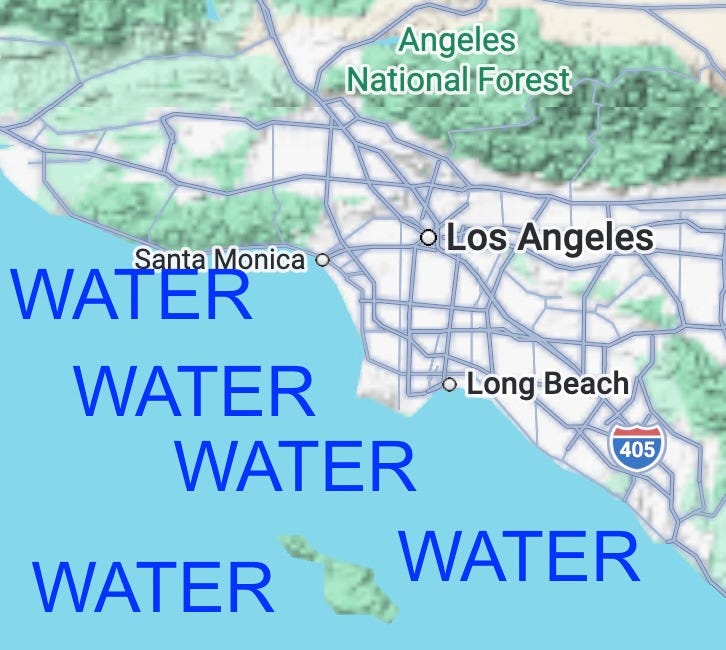
If you want to worry about water, worry about the alfalfa and almonds in the Central Valley. 80% of California’s water is used by the state’s extremely thirsty farms. All the cities and towns use just 20%.
I decided to research what LA is doing to strengthen our water supply and plan for growth. I started by reading planning documents from the LA Department of Water and Power (LADWP) and LA Sanitation. I also studied the amazing work by UCLA and LA Waterkeeper on how the city can achieve a sustainable water supply. What I read was heartening - the city has big plans to reduce our dependence on snowmelt and switch to more dependable sources. More on that later.
But I also found something that maybe shouldn’t have surprised me. LADWP and Sanitation aren’t planning for growth. They assume LA’s population barely budges in the future. LADWP forecasts it will serve only about 12% more people in 2050 (p. 1-5).1
I want to see LA grow to 10 million people by 2075 - 160% more people. If the city isn’t planning for that kind of growth, I’m going to take a crack at it.
Modeling a city of 10 million
To figure out how much water 10 million Angelenos might use, I built a parcel-by-parcel growth model that could reasonably get LA to 10 million by 2075. The model is driven by recent housing policy innovations like CHIP, SB 79, townhomes, duplexes, and ADUs. I added YIMBY wishlist items like condo reform and single-stair. I assumed the city’s final SB 79 plan would focus growth in wealthier neighborhoods near transit where more people deserve to live. And I allowed 3-4 story buildings in wealthy neighborhoods farther from transit.
I did all this work because I wanted to figure out how many sprinklers would be eliminated as the city grows to 10 million. Fifty-four percent of the water used in single-family homes in LA irrigates the yard. The more apartment buildings that are built replacing yards, the less water each resident will use.
The model projects that to get to 10 million Angelenos, about 23% of the city’s houses would be torn down to build apartment buildings and townhomes. That’s 130,000 thirsty backyards gone. Another 205,000 houses would get ADUs or duplexes in their backyards, shrinking their lawns and reducing water use. Altogether, 30% of the city’s irrigated yard space would be eliminated. Not watering those yards alone would cut the city’s total water use by 10%.
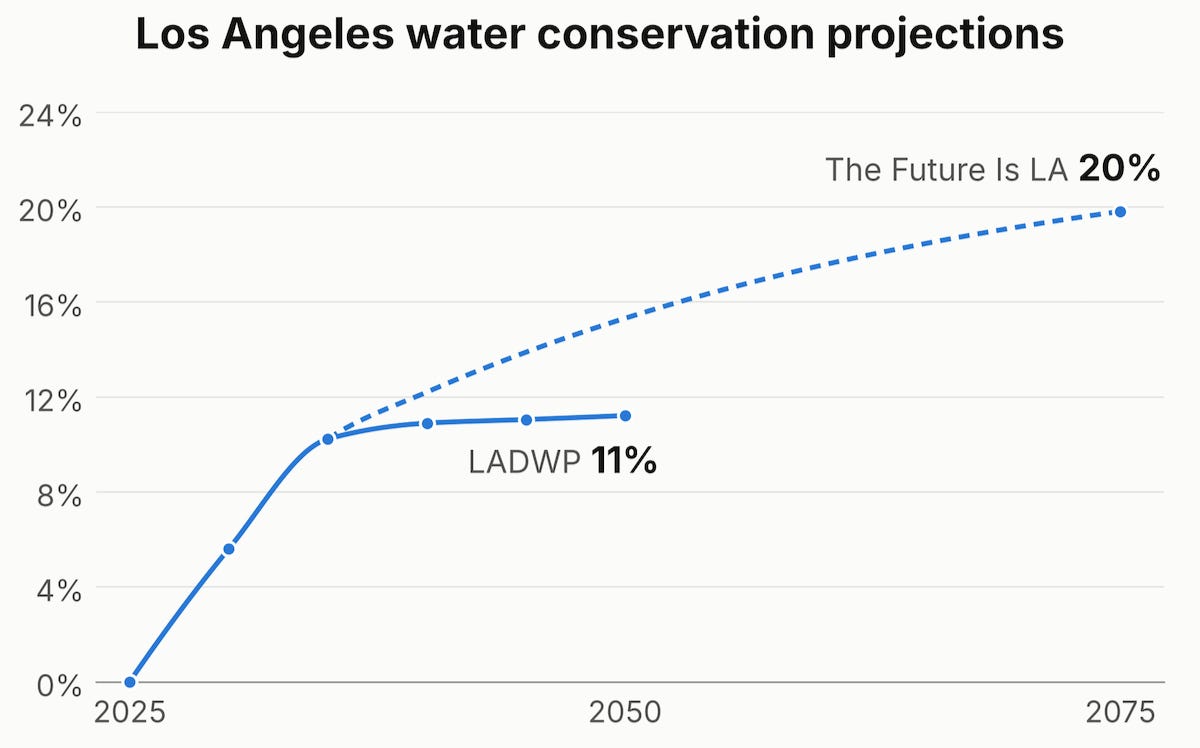
Even more water would be saved by conservation. I mentioned LA’s incredible strides in water conservation over the last couple decades. LADWP projects conservation will continue to increase but then level off at 11% around 2035 (“Additional conservation” in Exhibit 2G). That’s basically when the last old washing machine will have died and been replaced. A separate 2017 LADWP study said achieving more conservation would require mandates and was therefore “logistically unenforceable.”
I’m more bullish. LADWP admits its conservation forecasts have always been too conservative (Exhibit 9A). Surely there’s plenty of potential for innovation in the field of water conservation without mandates. Maybe one day we’ll wash our dishes with lasers. I built the model using a more optimistic curve for future water conservation, lowering the citywide demand by 20% in 2075.
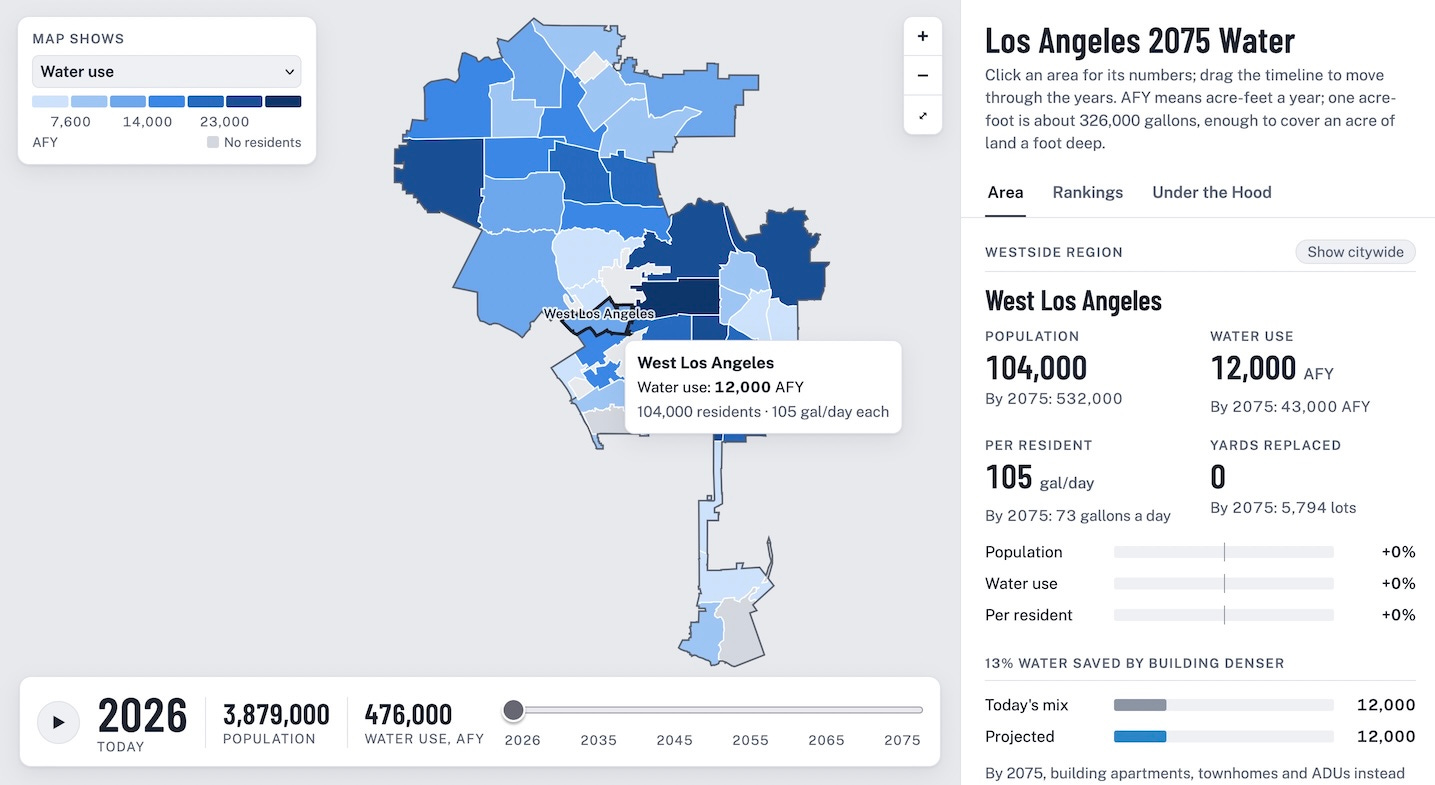
All in all, the model projects that in 2075 every person will use about two-thirds the water they use today. Per capita water usage would be about 75 gallons a day, basically what San Francisco used last year (Figure 4-2). That makes sense: an LA of 10 million people would be about as dense as the City by the Bay.
The bottom line is that even as we grew from 3.9 million to 10 million Angelenos, a 160% increase, the city would use only 76% more total water than we do today. I made an interactive map so you can explore all the details:
Where will the water come from?
We’re going to build a water system with four main sources that can supply 840,000 acre-feet of water per year (AFY), up from 476,000 AFY today (Exhibit ES-G). And we’re going to make our water supply more robust, reducing our dependence on snowmelt and other climate-sensitive sources.

1. Wastewater purification (450,000 AFY - 52% of the total): The city’s Pure Water LA project will purify wastewater at the massive Hyperion Wastewater Reclamation Plant next to Dockweiler Beach. Sure, wastewater has poop in it, but once you take that out it’s just water that can be treated. (Fun fact: once processed, much of Angelenos’ poop is trucked to Kern County to be used as fertilizer at Green Acres Farm, which is owned by LA Sanitation.)
Currently, Hyperion treats our wastewater and dumps it into the ocean. Pure Water LA would purify it further and recycle it for household use. Plenty of places have been purifying their wastewater for decades, including Orange County. Once fully built out, LADWP says Pure Water LA could produce about 230,000 AFY of water, a big chunk of what our growing city will need.
But the plans for Pure Water LA don’t include growth. 10 million Angelenos would send much more wastewater to Hyperion for purification. LADWP says Hyperion has “flexibility in space planning” (p.5) for future growth, but they don’t say how much. Let’s say Pure Water LA will purify 300,000 AFY by 2075.
Meanwhile, the Metropolitan Water District, from whom LA buys a bunch of water imported from the Sierras and Rockies, is planning its own wastewater purification plant in Carson. Confusingly, it’s called Pure Water Southern California (does nobody at these agencies talk to each other?). That plant could produce 155,000 AFY of potable water, a portion of which LA could purchase. If MWD sold the city recycled water instead of faraway snowmelt runoff, that would go a long way toward building our water system’s resilience. Let’s say we’ll buy 50,000 AFY from them.
The city also recycles some wastewater as non-potable “purple pipe” water to be used for things like irrigating parks. Currently, 13,000 AFY are recycled, and volume is planned to expand to about 20,000 AFY (Exhibit 7G, “Municipal and Industrial Uses”).
LADWP and Sanitation are also building a wastewater purification project at the Tillman Plant in the Valley. The first phase opens in 2028, and once Phase 2 is complete, it will treat 40,000 AFY. There are proposals to expand it (Appendix D), and a bigger population will increase the flow of wastewater the plant can treat. Let’s double Tillman’s capacity by 2075 to 80,000 AFY. Much of the water purified at Tillman would be stored as groundwater. Which leads us to…

2. Groundwater (110,000 AFY - 13%): The aquifer under our feet helps the water supply in two ways. First, it collects rain, which we can pump out through wells. Second, the aquifer is Mother Nature’s reservoir - we can pump water in for storage and pump it back out later. In total, LA has the right to pump about 110,000 AFY (Exhibit 5A) of groundwater, mostly in the Valley.2 The problem is that we haven’t just put water in the ground. We’ve put in pollutants too, so many that the aquifer is too dirty to pump. In 1986, the EPA designated four East Valley industrial areas as Superfund cleanup sites, and LADWP had to drastically reduce the amount of water it pumps there, from a 1989 peak of 137,000 acre-feet to 26,000 currently (Exhibit 5C).
We can increase our local groundwater supply from 26,000 AFY to the maximum 110,000 AFY by cleaning up the Valley aquifer. The city has already embarked on several groundwater remediation projects that identify the wells where the pollutants are most heavily concentrated, pump the dirty water out of the ground, and filter out the pollutants. Two projects are up and running, and a third will open next year, combining for 103,000 AFY.
The only way we could greatly increase groundwater pumping beyond that rate is to go to court. The 110,000 AFY limit is set by several legal settlements protecting the aquifer. Perhaps if global warming increases the average rain that falls on the city, we could someday convince a judge to increase the amount of water we are allowed to pump back out. But only if we do…
2a. Stormwater capture: Roughly 375,000 acre-feet of rain fall on the city every year.3 About four-fifths drains to the ocean, picking up pollutants along the way that damage our beaches and marine ecosystems. Much of the rest is soaked up by the green parts of the city. Only about 50,000 AFY are captured by the city and used in our water supply.4
LADWP’s Stormwater Capture Master Plan sets a goal of capturing 150,000 AFY, or 40% of the rainfall, by 2035. Lucky for us, Measure W, a 2018 LA County ballot measure, created a steady funding stream for building more stormwater capture infrastructure, and projects are starting to get built.
Adding stormwater capture doesn’t increase the overall water supply. It’s stored in the aquifer, and the court determines how much we can pump out. But stormwater capture does change the mix of where our water comes from, and that’s important. Every acre-foot of stormwater captured and stored is one the city doesn’t have to import from a climate-endangered source.

3. LA Aqueduct (100,000 AFY - 12%): I debated whether to keep this source. It’s the city’s cheapest water, and it even generates hydropower for us as it flows downhill from the Owens Valley to LA. But it also depends on climate-sensitive Sierra snowpack, and I don’t think we should rely on it as heavily as we do now. Let’s cut the city’s projected use in half, from 193,000 AFY to 100,000. We can bank any surplus in a wet year by storing it in the Valley aquifer.

4. Desalination (200,000 AFY - 23%): This is the big untapped technology, the one that uses the greatest source of water on Earth. San Diego operates the largest ocean desalination plant in the country, generating about 50,000 AFY. Desal is expensive, but it’s getting cheaper, and a promising pilot project will soon be tested off the Malibu coast. I think we should go long on desal. Many cities in the Middle East and Australia use it for much of their water supply. Several desalination plants in the Middle East purify 200,000 AFY today.5 Surely we can build that capacity here in the next 50 years.
The 10 million Angelenos water system vs. 2025
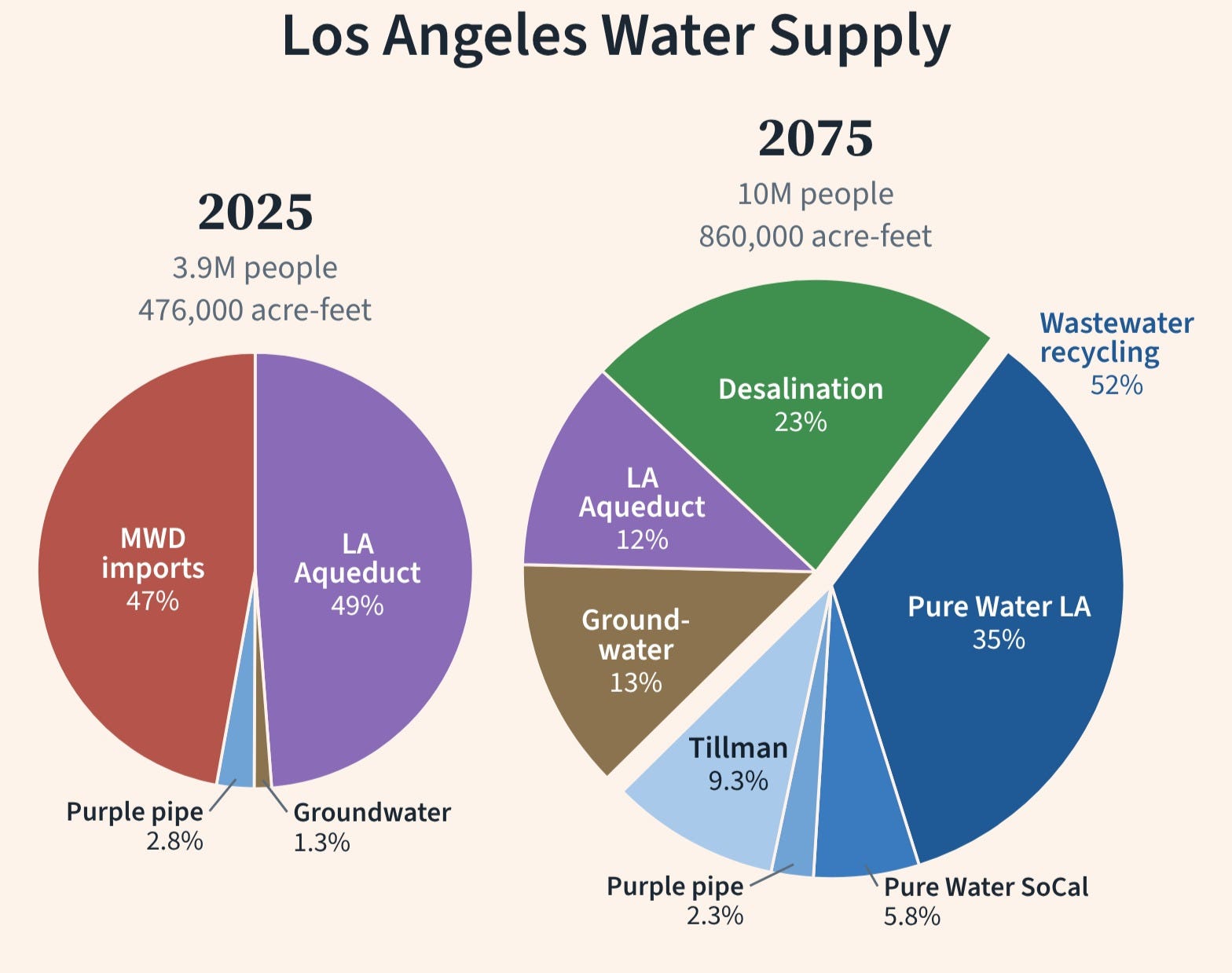
In this scenario, only 12% of our water would come from snowmelt, a bit better than the current 96%! Three-fourths of our water supply would be climate-safe: recycled wastewater and desalinated ocean water. LA would decouple itself from the drought cycle and establish a sustainable water supply for its 10 million citizens.
The story of growth in LA has always been a story of water. A century ago, William Mulholland’s aqueduct opened the door for millions of California Dreamers to thrive here. If we change the water story we tell today, we can tap back into that growth mentality for generations to come.
LADWP serves several neighborhoods outside of the City of Los Angeles, so its population numbers don’t track exactly with the city’s population.
Actual hard groundwater rights add up to about 66,500 AFY. LA aqueduct water is also stored in the Valley aquifer, and we are entitled to pump out 20.8% of it, which works out to an average of around 43,000 AFY (p. 5-5). Total: 109,809 (Exhibit 5A).
Average annual rain is about 15” = 1.25’. City area is 469 sq. mi. = about 300,000 acres.
The city captured 29,000 AFY in 2015 (p. ES-2), and they’ve added about 19,000 AFY since then (64,000 on p. 64 here, 83,000 here).
The Wikipedia page lists plants’ capacity in cubic meters. 200,000 AFY is about 675,000 m3.