


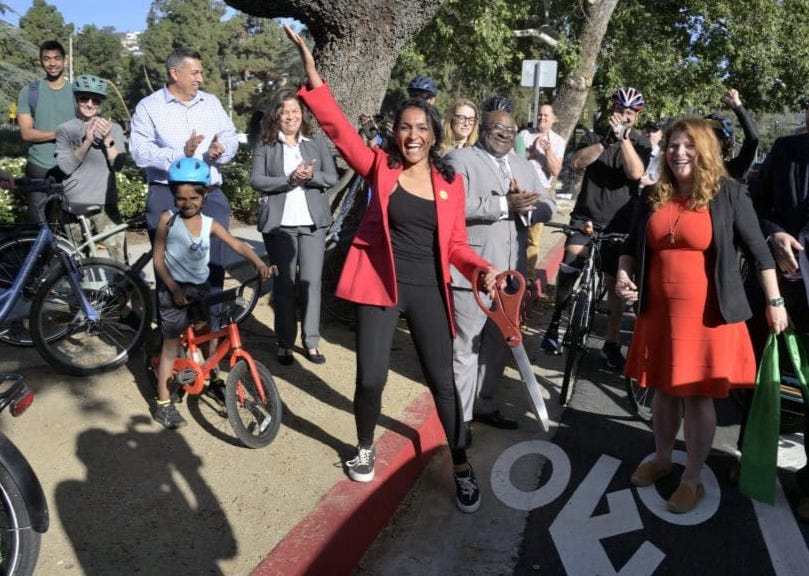
What an incredible feeling to know that Los Angeles’ next mayor, Nithya Raman, wants our city to have abundant housing and robust mobility. Even better, she put those urbanist issues front and center during the election. No mayor has campaigned on housing and mobility in LA the way Raman did. By staking her claim as the urbanist candidate, Raman also raised the stakes for herself to deliver on urbanism. Just as Karen Bass was judged on her signature issue, homelessness, our new mayor will be judged on housing and mobility.
On housing, our new mayor has an opportunity to offer new, ambitious ideas to address LA’s crushing housing shortage. But the fights could be hard. For decades, the city has only been willing to take baby steps on housing for fear of a NIMBY backlash. Raman’s dominant electoral performance could potentially put an end to this cautious dance with homeowners, but it won’t be easy. I’m looking forward to seeing what ideas she puts forward.
Mobility is in a different spot. Ambitious, popular plans are already in place. But political structures and bureaucracy have stifled progress, whether at Metro or on HLA. Raman has made some positions clear, such as supporting a special funding district to accelerate the K Line extension to Hollywood. But she has many other decisions to make to achieve her vision of mobility.
Here’s what I’d ask her.
(clears throat)
Hi, Mayor-elect Raman!
Housing
1. How to implement SB 79?
As you know, SB 79 went into effect in July, allowing apartments near transit stops across California. But not in LA. With some clever preemptive upzoning, the city got a free pass from the law until 2030.
Now we have two years to submit our SB 79 implementation plan to the state. The law spells out how tall and dense buildings can be at different distances from each station. It also provides some flexibility to shift things around - a bit taller here, a bit shorter there - as long as the total number of new homes allowed remains the same.
City Council says it wants to “emphasize” height and density in wealthier neighborhoods. Do you believe them? Will you ask them to allow buildings taller than SB 79’s default 5-9 stories in wealthy neighborhoods? Even the wealthy single-family neighborhoods? Even the wealthy historic neighborhoods, like the Miracle Mile?
Also, how important is feasibility to you? Zoning for more than 5-9 stories may not generate any more homes, because taller buildings come with extra requirements that make them much more expensive to build. What if the big upzoning ends up being a fake upzoning?
Finally, will you push to plan the new SB 79 neighborhoods holistically? Thousands more people will eventually live around each transit stop. How will you plan for the parks, libraries, schools, and all the other services those people will need?
2. How to fix ULA?
You’ve said you want to reform ULA, the “mansion tax” that also taxes apartment buildings. ULA is one reason apartment construction has collapsed in the city, worsening our already crushing housing shortage and eventually driving up rents. The mansion tax ended up being a tax on renters.
Some advocates want to exempt new apartment buildings from ULA for the first 15 years after they are built. In February, you couldn’t get your fellow City Councilmembers to put forward a ballot measure with that language. The exemption would have reduced ULA tax revenues, so opponents framed the measure as “gutting ULA.” And the opponents are powerful, including labor, which loves the affordable housing construction jobs that ULA funds.
There is a way to build a bigger coalition: broader ULA reform that increases revenue. An exemption for new apartment buildings could be offset by lowering the threshold at which ULA kicks in. Currently, all real estate sales over $5.4 million are subject to the tax. A threshold of, say, $3 million would apply ULA to more transactions and generate more revenue. But that also means a “mansion” gets redefined down to $3 million, which will anger homeowners.
What does your ULA ballot measure look like, and who will be in the coalition that helps you pass it?
3. What to allow in single-family neighborhoods?
You’ve expressed interest in tackling LA’s famous single-family zoning, which has already started to crack. State laws have allowed homeowners to build gentle density in their backyards. A trickle of townhomes has begun to replace bungalows, again thanks to state law. But more needs to be done. Single-family lots are the best sites in the city for redevelopment - they are cheaper than commercial lots and don’t have tenants that need protecting. Many of them are in wealthy, highly segregated neighborhoods where more people of all kinds deserve to live. How hard will you lean into upzoning these areas?
Last spring, City Council took a first shot at upzoning single-family neighborhoods with a program called Low Rise that allows 3-4 story apartment buildings near transit. So far, it’s been a dud - zero buildings proposed as of November 1st. The failure may be due to overly restrictive requirements, or 3-4 story buildings may simply be too small to work financially. Will you start by tweaking Low Rise? Or will you scrap it for something more ambitious?
4. How to make LADWP change its ways?
You’ve talked tough about using your mayoral powers to bring bureaucratic change. No agency needs change more than the Department of Water and Power. DWP horror stories have become commonplace among LA developers. Completed apartment buildings sitting empty for months, waiting for power to be turned on. Exasperated Palisades homeowners rebuilding with generators. Requirements for hideous transformers to be situated right in front of buildings.
Your housing platform includes good policy reforms for DWP. But the question is not about policy. It’s about bureaucracy: how do you get DWP to actually do what you want? The agency is uniquely dysfunctional, opaque, and resistant to reform. You already passed DWP reforms as a City Councilmember, and all you got back was a perfunctory report saying everything was fine.
What is your theory of change at DWP? When should Angelenos expect different results?
Mobility
5. How fast can streets be repaved?
In the last fiscal year, the city only resurfaced 126 lane miles, a pace that would get all LA’s streets repaved in 175 years. This colossal failure of basic governance stems from decades of neglecting the city’s curb ramps. The vast majority of LA’s ramps are out of date and need rebuilding, and a street can’t be repaved until its ramps are fixed.
In other words, the pace of repaving is dictated by the pace of curb ramp reconstruction. The city is only fixing a few hundred ramps a year out of almost 100,000. How many curb ramps do you intend to build?
6. Use this trick to speed up bike lane delivery?
Bike lane installation is also closely tied to curb ramps, because city policy says bike lanes can only be installed on good pavement. Since most of our streets are in bad shape, and almost nothing’s being repaved, the pace of bike lane installation has slowed to a crawl. Meanwhile, 300 people are killed by cars on our streets every year. More than are murdered in LA.
The way out of this public health crisis is to repeal the good pavement requirement. Will you do it? Let LADOT install life-saving bike lanes inexpensively where they are needed, while fixing whatever potholes need fixing. Unlink traffic safety from repaving and curb ramp construction. Make installing bike lanes as fast and cheap as installing bus lanes.
How will you get City Council to go along? Disability advocates might oppose the change, fearing the city would end up fixing fewer curb ramps. To defuse the opposition, you could pair this change with the curb ramp surge from #5, and you could really get cooking with street safety.
7. How hard to lean into traffic cameras?
Sacramento has led a quiet street safety revolution in recent years, allowing California cities to enforce several kinds of traffic laws with cameras - parking at a bus stop or in a bus lane, driving over the speed limit, and running a red light.
In LA, each of those kinds of camera enforcement is in various stages of implementation or exploration. Cameras are already deployed on several Metro and DASH bus lines, speed cameras were installed last month at 125 locations across LA, and City Council asked LADOT last year to look into implementing red light cameras.
Automatic enforcement brings two much-needed benefits: saving lives and generating revenue. For a city with a failed Vision Zero program, these new tools could be a godsend. And I don’t have to tell you how badly we could use the revenue.
These programs are all basically pilots that could be greatly expanded. And they work. Bus camera enforcement generated millions in revenue for LA in its first year and led to a one-third reduction in violations. Speed cameras have been so successful in San Francisco that advocates are calling on the city to install more. If these programs succeed here, how fast will you push to expand them?
8. Push for congestion pricing?
The success of road pricing in New York is spurring other cities to look into it. Even the Trump Administration may be coming around. In LA, Metro has been studying congestion pricing since 2019, and they released the results of their latest round of modeling late last year. The numbers are dizzying - 40% less traffic delay inside the priced areas, 20% more transit use across the entire LA County, and $600 million in yearly revenue.
Pricing roads is hard politically. Is this a fight you want? If so, an obvious pilot project is sitting in plain sight: LAX. The people mover will open eventually, God willing. Passengers who take rideshare or taxis to the airport already pay a fee to enter the horseshoe, so the concept is not new. And traffic at LAX is famously awful.
While you consider congestion pricing at LAX, will you cancel the airport’s insane roadway expansion project?
9. How to reform the Metro board?
LA Metro is hobbled by its 13-member board, which consists almost entirely of politicians from across LA County who barely care about public transportation and certainly don’t ride it. Just this year, the board’s political decisions likely killed a light rail line to Torrance and needlessly delayed picking a final route for the K Line extension to Hollywood.
You will put your stamp on the board immediately, as you will chair it and appoint three new members. But a reckoning is coming that will force the board to be restructured. By law, all 5 County Supervisors sit on the board. But we’re getting an elected County Executive in 2028, and in 2032 the number of supervisors will expand to 9.
The changes at the County could be an opportunity to add political allies to the board or to reform it more broadly. Should the board expand so the executive and all nine supes sit on it? How about depoliticizing the board by adding actual subject matter experts - people who work in transportation and land use? How about adding a requirement that all board members ride Metro once a week?
The Metro board’s structure is set by state law. You have credibility on transit and a powerful position as board chair. You’re well positioned to advocate in Sacramento for your vision of a new Metro board. What is that vision?
10. What legacy public space project to pursue?
Big visions for public space in LA come and go. The park over the 101 in Hollywood. The Silver Lake Reservoir master plan. The Pershing Square redo. Our city has seemingly gotten out of the business of taking big swings. Do you want a turn at bat?
Perhaps you can pedestrianize a street or five. Hollywood between Highland and La Brea? Broadway in the Historic Core? Wilshire through MacArthur Park? Or you could focus on transforming the LA River, with many plans already in place. Or lead the creation of a big new public space like San Vicente Park (I’m on this organization’s board, ask me anything!). Or plan for something amazing to replace the Inglewood Oil Field next to Kenneth Hahn State Park once it closes.
You are clearly a lover of LA. With a big public project or two, you could leave a lasting legacy for us all to enjoy.